
She was only nine years old when a devastating accident left her face severely burned and her future uncertain. Doctors feared there was little they could do. But Zubaida Hasan’s journey from a remote Afghan village to life-changing medical treatment in America became an extraordinary story of survival, compassion, and hope.
Some childhood memories are filled with laughter, family gatherings, and carefree afternoons. For Zubaida Hasan, one terrible moment changed everything.
In 2001, a fire accident in Afghanistan left the young girl with devastating burns across her face, neck, and upper body. The injuries were so severe that ordinary activities most children take for granted became painful challenges.
Her family feared that she might never recover.
But what happened next would take Zubaida thousands of miles from home, bring her into the care of an American military doctor, and introduce her to surgeons determined to give her a chance at a better life.
Her story would eventually touch hearts around the world.
The Day Everything Changed

Zubaida was born into a nomadic family in Afghanistan’s Farah province. She grew up with her parents and eight siblings in a community where access to advanced medical care was extremely limited.
In August 2001, when Zubaida was just nine years old, she was pouring kerosene into a cooking stove that was still hot.
Suddenly, the fuel ignited.
Flames engulfed her clothing and spread across her body, causing severe burns to her face, neck, chest, and arms.
Her family extinguished the flames, but the damage was already devastating.
Her father, Muhammad, rushed her to a local medical provider, where she received basic treatment. Unfortunately, her injuries required specialized care that was not readily available.
As the days passed, her condition became increasingly serious.
Her father refused to stop searching for help.
He took Zubaida across the border to Iran, hoping that doctors there could save his daughter. She remained hospitalized for approximately 20 days.
But the medical team could offer little hope. According to accounts published by the Grossman Burn Foundation, doctors advised Muhammad to take his daughter home, believing she would not survive.
Yet Zubaida did survive.
And that was only the beginning of her extraordinary journey.
Grossman Burn Foundation+1
A Childhood Trapped Behind Severe Scars
Although Zubaida survived the initial burns, her injuries continued to affect her body.
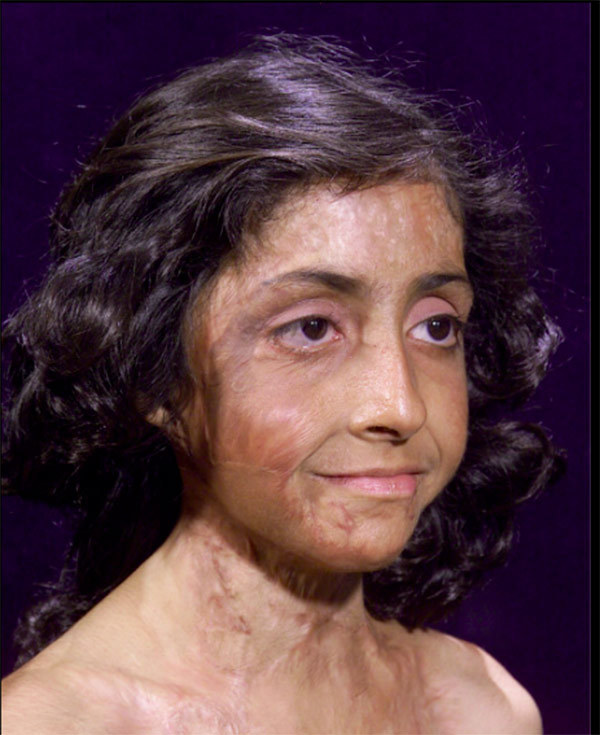
As the wounds healed, thick scar tissue developed across her face, neck, and upper torso.
The scar tissue contracted, pulling her chin toward her chest and restricting her movements.
Her eyelids were affected so severely that she could not fully close her eyes. Her mouth was also pulled out of its natural position, making eating difficult.
One of her arms became restricted by scar tissue.
These were not simply cosmetic injuries. They interfered with basic physical functions and caused considerable discomfort.
At an age when most children were learning, playing, and making friends, Zubaida faced a daily struggle with injuries that had transformed her appearance and limited her independence.
But her father still believed that somewhere, someone might be able to help her.
The Desperate Decision That Changed Her Future
In February 2002, Muhammad brought his daughter to an American military base in Kabul.
It was an extraordinary decision for a father who had already traveled far beyond his home in search of medical assistance.
At the base, American military doctors examined Zubaida and recognized the seriousness of her injuries.
They began contacting officials and humanitarian organizations to determine whether specialized treatment could be arranged.
Eventually, her case reached Dr. Peter Grossman, a plastic and reconstructive surgeon at the Grossman Burn Center in Sherman Oaks, California.
Grossman had experience treating severe burn injuries, but even he was deeply affected by Zubaida’s condition.
The medical team believed that reconstructive surgery could restore important functions and significantly improve her quality of life.
With assistance from the Children’s Burn Foundation and other organizations, arrangements were made to bring Zubaida to the United States.
In June 2002, the young Afghan girl arrived in California.
She was thousands of miles from the familiar surroundings of her childhood, facing an uncertain series of difficult medical procedures.
But for the first time since the accident, she had access to a team capable of addressing the damage caused by her burns.
ABC News+1
Twelve Major Surgeries and a Remarkable Transformation
At the Grossman Burn Center, doctors developed an extensive reconstructive treatment plan.
The first priority was to release the scar tissue that had pulled Zubaida’s face toward her chest.
During her initial operation, surgeons carefully separated the contracted tissue and worked to restore movement to her neck and face.
Subsequent procedures involved skin grafts, including healthy skin taken from other areas of her body.
Doctors also addressed the damage affecting her eyelids, mouth, arms, and other injured areas.
The work required extraordinary precision, careful planning, and repeated recovery periods.
Over approximately one year, Zubaida underwent 12 major operations.
Her treatment involved far more than surgery alone. She also received physical therapy and psychological support to help her adapt to the changes in her body and life.
Each procedure brought its own challenges.
There were painful dressing changes, difficult recoveries, and the emotional strain of being separated from her family.
But the results gradually became visible.
Her neck regained movement. Her facial features became less restricted by scar tissue. Her ability to perform ordinary activities improved.
Doctors were not simply changing her appearance. They were helping restore functions that the accident had taken away.
And as her recovery progressed, another remarkable transformation was beginning.
Grossman Burn Foundation+1
The Little Girl Who Began Smiling Again
Zubaida’s recovery was not limited to the operating room.
During her treatment, she began experiencing parts of childhood that had previously been unavailable to her.
She attended Round Meadow Elementary School in Calabasas, California.
It was the first time she had attended school.
Despite arriving with little English, Zubaida learned the language rapidly. According to the Grossman Burn Foundation, she made remarkable progress in approximately 12 weeks.
She began making friends and participating in school activities.
The girl who had once struggled with severe physical limitations was now attending classes, laughing with classmates, and enjoying new experiences.
Dr. Grossman and his wife, Rebecca, became her legal guardians while she continued her medical treatment.
Their home provided a supportive environment where Zubaida could recover and experience everyday family life.
She developed friendships, enjoyed music, and discovered new interests.
On March 22, 2003, she celebrated her 11th birthday with her first sleepover party.
It was a simple childhood milestone, but its significance was enormous.
Only a short time earlier, her survival had been uncertain.
Now she was celebrating with friends.
Her recovery had given her more than improved physical abilities. It had opened the door to experiences that severe injuries had nearly taken from her.
Grossman Burn Foundation+1
A New Face, but an Even Greater Victory
Before-and-after photographs of Zubaida’s recovery eventually attracted international attention.
The images showed the dramatic difference between her condition following the accident and her appearance after reconstructive treatment.
For many viewers, the transformation was difficult to believe.
But the photographs represented only part of the story.
Behind the visible changes were months of medical treatment, the dedication of surgeons and nurses, the persistence of her father, and Zubaida’s own determination.
The surgery did not erase every scar.
Severe burns can leave lasting physical and emotional effects, even after successful reconstruction.
Nevertheless, her progress demonstrated how specialized medical treatment could dramatically improve the life of a child with serious burn injuries.
The most important achievement was not that she looked different.
It was that she could move more freely, participate in school, enjoy friendships, and approach life with renewed possibilities.
Returning to Afghanistan
After completing her major course of treatment, Zubaida was reunited with her family in Afghanistan.
Returning home meant leaving behind the doctors, guardians, teachers, and friends who had become an important part of her life in California.
But it also meant returning to the parents and siblings who had waited for her.
Her experience had given her new opportunities and aspirations.
As a child, Zubaida spoke about wanting to become a pediatric doctor and help rebuild her country.
Her story also continued to influence humanitarian medical work.
The Grossman Burn Foundation has described her as an ambassador for burn survivors, and she later helped support awareness of other children needing treatment.
Her experience became an example of what could happen when medical professionals, humanitarian organizations, and communities worked together to help someone facing extraordinary circumstances.
Grossman Burn Foundation+1
The Powerful Lesson Behind Zubaida Hasan’s Story
Zubaida Hasan’s journey began with a terrible accident in a remote Afghan village.
Her family had limited resources. The medical treatment she needed was far beyond what was available locally.
At one point, her father was advised that there was no realistic hope for her survival.
But he continued looking for help.
That determination eventually connected his daughter with people who had the skills and resources to treat her injuries.
The result was an extraordinary recovery that captured international attention.
Her story is a reminder that reconstructive surgery is not simply about changing someone’s appearance. For people with severe burns, it can restore essential movement, protect vulnerable areas of the body, reduce physical limitations, and improve daily life.
It is also a story about the importance of access to medical care.
Without her father’s persistence and the assistance of the organizations involved, Zubaida might never have received the specialized treatment she needed.
Most importantly, her story reminds us that a person’s future cannot always be predicted by the severity of their injuries.
A little girl who once faced an uncertain future eventually returned to school, formed friendships, celebrated birthdays, and dreamed of helping others.
Zubaida Hasan’s greatest transformation was not simply the recovery of her face. It was the recovery of opportunities, independence, and the chance to enjoy her childhood.
And that is what makes her story unforgettable.