I still cringe whenever I remember the exact words that left my mouth.
“If you can make my kids walk, I’ll adopt you.”
Laughter spread around the room. I laughed too, holding a half-finished glass of scotch.
My wife, Clara, didn’t smile. “Richard, stop it. That’s enough.”
We were hosting an important charity gala at our estate in Aspen, Colorado.
Successful executives, respected surgeons, and foundation directors gathered beneath crystal chandeliers—people accustomed to signing six-figure donation checks without always looking directly at those they hoped to help.
I was one of them.
I had built Valdes Global Enterprises after inheriting a modest construction business from my father.
At forty-four, I owned luxury resorts, commercial properties, and had more money than I could realistically spend across three lifetimes.
Yet I couldn’t purchase the one thing in the world I wanted most: for my eight-year-old twins, Matthew and Mila, to walk again.
Two years earlier, a serious highway accident outside Denver had caused incomplete spinal cord injuries for both children. Neurological tests showed limited preserved nerve activity, but despite numerous procedures, intensive therapy, and consultations with leading specialists in New York, London, and Madrid, both still relied entirely on wheelchairs.
That evening, I had consumed a little too much alcohol.
Then I noticed the boy.
He looked no older than nine, dressed in an oversized button-down shirt, worn jeans, and no shoes.
An event coordinator quietly pulled me aside and explained that his name was Noah and that he often stayed at a nearby shelter supported by our corporate foundation.
He wasn’t watching the ice sculptures or admiring the trays of expensive food.
He was staring directly at my children’s legs with such focused, silent concentration that, for reasons I couldn’t explain, it bothered me.
So I made my thoughtless, arrogant joke.
The laughter across the ballroom immediately faded when Noah raised his head and met my gaze. “Are you serious?”
I hesitated over my answer, suddenly feeling embarrassed.
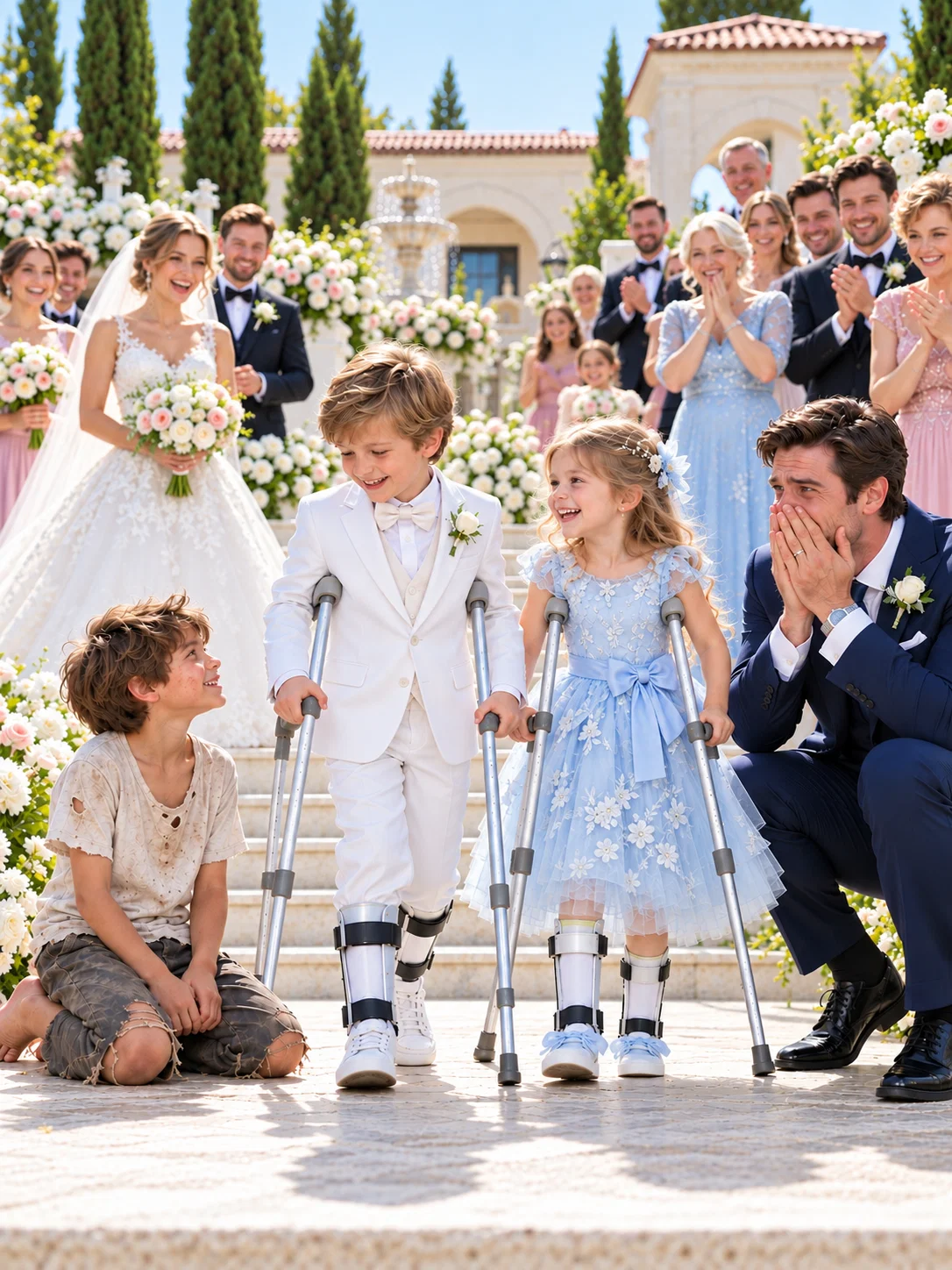
He walked around me and stopped between Matthew and Mila’s wheelchairs. “Can I touch them?”
Clara moved forward anxiously. “Noah…”
“Let him, Mom,” Mila said quietly.
Noah knelt on the polished floor between their chairs. He placed his right hand behind Matthew’s right knee and his left hand along the inside of Mila’s calf. He didn’t press forcefully; instead, his fingers moved in a careful, deliberate pattern, almost as though he knew exactly which anatomical points he wanted.
That immediately caught my attention. He didn’t seem to be guessing.
“Breathe slowly,” Noah murmured.
Matthew gave an uneasy laugh. “Are you a doctor?”
“No.”
“Then we’re in trouble.”
Noah gave him a small, reassuring smile before applying gentle, focused pressure with his thumbs.
Matthew suddenly gasped.
Clara stepped forward. “What happened?!”
But Matthew wasn’t watching Noah. His eyes were fixed on his right sneaker.
“Mom…” Matthew whispered, his voice shaking.
His sneaker moved slightly. Once. Then again.
Dr. Arthur Vance, a leading pediatric neurologist sitting nearby, hurried over. “Don’t move him!”
Mila grabbed my wrist tightly. Her eyes widened in disbelief. “Dad…”
“I’m right here, sweetie.”
“I feel something.”
I assumed she meant discomfort. “Where?”
“On my leg,” she whispered, staring at Noah’s hand. “I feel his fingers.”
The entire ballroom became completely quiet.
For two years, Mila had described everything below her waist as almost entirely numb—she could sometimes detect firm deep-tissue pressure, but never gentle contact against her skin.
Dr. Vance knelt beside her. “Mila, close your eyes.” He gently touched his pen against her calf. “Here?”
“Yes.”
He moved to the opposite side. “Here?”
“Left side.”
Dr. Vance looked toward me, his expression not joyful but completely puzzled.
Matthew held his armrests tightly. “I feel it too.”
“Don’t try standing, Matthew!” Dr. Vance instructed.
“But I can move my foot!” Matthew exclaimed. Then he did—a tiny but deliberate rotation of his ankle.
The movement was small, yet unmistakable.
Excited murmurs filled the room. I placed my hands on Noah’s shoulders, my pulse racing. “What did you just do? Who showed you that?”
Noah grew pale and looked toward the floor. “Just what I was taught.”
“By who?”
“I… I don’t know what I’m supposed to say.”
That single response changed everything.
We ended the gala early and brought the twins to a private children’s hospital in Denver. I asked Noah to come with us—I couldn’t simply let him disappear after everything we had just witnessed.
During the drive, we offered him a brand-new pair of sneakers from Matthew’s closet. They were too big, so Noah chose to hold them carefully in his lap instead.
“Where do you sleep, Noah?” Clara asked gently from the front seat.
“Sometimes at the shelter. Sometimes at a church.”
“Where is your family?”
“I don’t have one.”
“Your parents?”
“I don’t know where they are.”
I turned around from the passenger seat and looked at him. “How did you get into my house tonight, Noah?”
Noah tightened his hands around the sneakers. “A lady told me to go there.”
A strange chill moved through me. “What lady?”
“She was sitting outside the shelter.”
“Did she know you?”
“She knew my name.”
Clara and I exchanged a concerned glance. “What did she tell you?”
Noah paused for several seconds. “She said you needed to remember someone.”
“Remember who?”
“She didn’t give me a name.”
At the hospital, detailed neurological testing revealed something remarkable: the twins’ spinal !njuries had never involved complete anatomical separation.
Some nerve pathways remained intact, although their electrical signals had appeared clinically inactive for two years.
That evening, doctors detected a significant increase in conduction.
Nobody called it a miracle. None of the doctors could completely explain what had occurred.
However, Dr. Vance offered an important observation: “The boy applied targeted pressure near peripheral nerve access points sometimes used in advanced neuro-rehabilitation.”
I approached Noah in the waiting room. “Who taught you that particular technique?”
He shrugged, looking tiny in the oversized hospital chair. “Aunt Mayra.”
“Was she a physical therapist?”
“She took care of sick people.”
“Where is she now?”
Noah lowered his gaze. “She p@ssed away last winter.”
By seven the following morning, Matthew could wiggle his big toe when asked. Mila could clearly distinguish warm and cold sensations across both calves.
And while I struggled to understand how a barefoot child knew a technique that had produced such an unexpected response, a child protective services caseworker arrived to establish Noah’s legal identity.
There was no matching missing-person report and no active birth record under the surname he remembered.
Before the caseworker took him to temporary accommodation for further evaluation, Noah reached for my jacket sleeve.
“You promised,” he whispered.
Regret washed over me. “What I said at the gala was arrogant and unkind, Noah.”
His expression immediately changed.
I lowered myself to one knee so we could look directly at each other. “But I’m not going to act as though tonight never happened. Clara and I will work directly with Child Protective Services. If we’re legally allowed to foster you while they search for your family, we will.”
Clara stepped beside me and nodded firmly in agreement.
Noah released a long, unsteady breath, almost as though he had been holding it for hours.
Two days later, we brought the twins home.
One week afterward, following background checks, home visits, and temporary emergency authorization, Noah entered our front door as our foster child.
The first night, he slept fully dressed on top of the blankets.
The second night, he tucked two bread rolls inside his nightstand drawer.
The third night, Matthew challenged him to a wheelchair-versus-running race along our long hallway.
For the first time in two years, our house felt full of noise, laughter, and wonderfully chaotic life.
And that was when I started investigating the mysterious woman who had directed him toward my home.
Security footage from a camera outside the shelter showed a woman wearing a dark wool coat sitting beside Noah on a bench at 6:53 PM on the evening of the gala. She spoke with him for three minutes before handing him an envelope.
Her hood concealed most of her face, but when she extended her hand, a nearby streetlight illuminated her wrist.
She wore a delicate silver bracelet with a tiny crescent moon charm.
My throat suddenly felt dry.
I recognized that bracelet immediately. I had given it to Clara ten years earlier.
Or at least… that was what I had always remembered.
That night, once the children were asleep, I entered our bedroom and shut the door. “Clara, where is the crescent moon bracelet?”
Clara stopped what she was doing and slowly placed her earrings on the vanity. “I lost it years ago, Richard.”
“No, you didn’t.”
She remained completely still in her chair.
“The woman who gave Noah that photograph was wearing it,” I said quietly.
Clara slowly turned toward me, tears gathering in her eyes. At that moment, I realized my wife had been waiting twelve years for this conversation.
“I didn’t lose it, Richard,” she whispered. “I gave it away.”
“To who?”
“To the woman who was first at the scene of the twins’ car accident.”
For a moment, everything around me seemed unsteady.
“There’s something I never told you,” Clara said through tears. “Something your father made me promise to keep private.”
“What didn’t you tell me, Clara?”
She walked toward the closet, reached deep into the back of the highest shelf, and removed a small, faded wooden box. Inside it rested an old yellowed envelope.
“The woman who pulled Matthew from the damaged vehicle came to the hospital two days after the acc!dent,” Clara explained, her voice trembling. “When she noticed the silver bracelet around my wrist, she started crying. She said it belonged to your family.”
“I bought that bracelet for you!” I insisted.
Clara slowly shook her head. “That’s what you came to remember years afterward. But when you originally gave it to me, you said it had belonged to your biological mother.”
A sharp, pulsing ache appeared behind my temples. I clearly remembered buying it from a small boutique somewhere in Europe—or at least, I thought I remembered that.
Clara unfolded the yellowed envelope.
Inside was an old black-and-white photograph showing a modest house beside a river.
In front of it stood a young woman holding a baby.
I recognized the house immediately. I had lived there as a very young child, years before Arthur Valdes created his corporate empire.
Written across the back of the photograph in fading ink were five words: “Richard, your brother existed.”
I released a breathless, uncertain laugh. “I’m an only child, Clara. You know that.”
“That’s exactly what you told me when this letter arrived three weeks after the accident.”
I stared directly at her. “You’ve kept this letter for twelve years?”
“Your father begged me to keep it hidden!” Clara said, struggling with emotion. “Arthur was dying from cancer, Richard. When I showed him the letter, he pan!cked. He pleaded with me not to tell you.”
“Why? What did he tell you?”
“I asked him who ‘Daniel’ was.”
The name Daniel meant absolutely nothing to my conscious memory, yet my body reacted immediately. My hands started trembling, and an uneasy feeling moved through my stomach.
Before Clara could explain, a quiet knock came from the bedroom door.
Noah stood in the doorway wearing blue pajamas and holding a worn photograph. “The lady outside the shelter gave me this one, too,” he whispered, handing it over.
It showed two young boys sitting beside a riverbank. The older child appeared around six years old—it was unmistakably me as a boy. The other child was slightly smaller and held a wooden toy boat.
Across the back, written in uneven childish handwriting, were two names: “Richie & Daniel.”
Noah pointed toward the younger boy. “She said you needed to remember him.”
“Who was that woman, Noah?”
“She never told me her name,” Noah answered quietly. “And she didn’t send me there to heal your children. She only said to give you the picture once I knew you were listening. What happened with Matthew and Mila… Aunt Mayra taught me that exercise because she used to practice it with patients.”
Clara studied the photograph, covering her mouth with one hand. “Did Mayra know Daniel?”
Before Noah could respond, footsteps sounded from somewhere down the hallway.
Eight-year-old Mila appeared at the doorway—standing without her leg braces while gripping the doorframe to steady herself.
“Mila!” Clara exclaimed, quickly moving toward her.
My daughter smiled and carefully took one uncertain step, followed by another. Her left knee weakened, and I hurried across the carpet to catch her. She laughed joyfully through her tears as I held her.
“I walked, Dad!” she cried, wrapping her arms around my neck.
Matthew approached behind her in his wheelchair, smiling broadly. “That’s cheating! I’ve spent a whole week practicing how to wiggle my toes!”
I pulled both children close, unable to hold back my tears. Yet as I embraced them, my attention returned to the photograph Noah was holding.
Mila glanced over my shoulder toward the picture and blinked. “That’s Daniel.”
The entire room became silent.
I knelt directly in front of her. “How do you know the name Daniel, Mila?”
Mila frowned slightly and rubbed her forehead. “I don’t know… I heard Grandpa Arthur talking about him while he was sleeping at the hospital before he passed away.” She studied the photograph more closely. “There’s a red bicycle behind them in the grass.”
I turned the photograph around. Partially hidden beneath a faded patch of ink in the background was indeed the outline of a small red bicycle.
An intense memory suddenly surfaced in my mind: A red handlebar. Mud covering my shoes. A damaged brass bell. A voice calling, ‘Richie, wait for me!’
I leaned against the wall, struggling to process everything. “I had a red bicycle…”
The following morning, I hired a private investigator and contacted Dr. Vance. I didn’t want our family history to depend entirely on uncertain memories; I needed information that could actually be verified.
The investigator discovered historical employment records belonging to Mayra Escobedo. She had worked for more than fifteen years as a specialized home-health physical therapist. Thirteen years earlier, her primary client had been someone named Daniel Valdes.
Daniel was the same age as me. He had passed away three years earlier following complications related to an industrial accident.
Noah had never known Daniel was his father—Mayra had cared for him since infancy after his mother p@ssed away during childbirth, keeping his identity private because she feared Arthur Valdes’s legal representatives might become involved.
With court authorization, we gained access to a private storage unit Mayra had maintained in Denver. Inside were several boxes containing medical documents, childhood belongings, and a sealed letter labeled: “To Richard—if Noah ever finds you.”
My hands trembled as I opened it.
Mayra had written three detailed pages: Daniel wasn’t actually my half-brother.
He was my identical twin.
Arthur Valdes wasn’t our biological father. Our mother, Elena, had been married to a controlling and dangerous man named Rafael.
When the situation became increasingly unsafe, Elena escaped with her four-year-old twins. Arthur, then an influential local contractor, helped her stay hidden inside the isolated river house.
When Rafael eventually located them, a serious confrontation followed.
To protect the boys while remaining away from him, Elena and Arthur made a temporary and desperate choice: Arthur brought me to Denver under a different identity, while Elena’s sister cared for Daniel in New Mexico until the d@nger had passed.
But Rafael was never located. Elena became terminally ill three years afterward.
Then Arthur Valdes made a decision entirely on his own: he legally adopted me, concealed the public records connected to Daniel, and convinced me that my childhood memories were simply unusually vivid dreams.
When Daniel attempted to contact me at eighteen, Arthur’s legal representatives sent formal cease-and-desist notices, leaving Daniel convinced that I wanted no relationship with him.
Daniel spent his adult years working as a physical therapist and living a simple, private life, while I inherited Arthur’s fortune and business empire.
Clara held tightly to my hand while I cried inside the dim storage unit.
Thirty years of my life had been shaped by a story created by the man I had always called my father.
Noah came quietly beside me, holding the hand-carved wooden boat we had discovered inside one of the storage boxes. “So… Daniel was your twin brother?”
I looked down at the child who had my brother’s eyes. “Yes, Noah. He was.”
“And my dad.”
“And your dad.”
Over the following four months, our lives changed completely as we focused on truth, recovery, and rebuilding our family.
Court-ordered DNA testing formally confirmed that Noah was Daniel’s biological son, which made him my nephew.
Clara and I immediately began the formal legal adoption process, welcoming him permanently into our family—not because of an arrogant promise I had made during a gala, but because he already belonged with us.
Noah hadn’t developed any “magical powers” that evening.
Further medical reviews concluded that the twins’ neurological improvement resulted from gradual, long-term spinal recovery that had finally reached a critical stage. Noah’s targeted physical pressure—a technique his father had taught Mayra, which she later demonstrated to Noah—had simply activated a dormant reflex at precisely the right moment, giving my children the confidence to attempt movements they had avoided for years.
The mysterious woman wearing the silver bracelet was eventually identified as Sara Robles, one of Mayra’s close friends who had been present near the accident scene years earlier. She had preserved both the family photograph and bracelet, waiting until Noah was old enough to enter a secure environment before ensuring that our paths finally crossed.
With intensive physical therapy, Mila gradually progressed from wearing leg braces to using a cane, while Matthew regained enough strength to stand and walk short distances with assistance.
One cool autumn afternoon, we traveled to the old river house in New Mexico, which we had purchased and carefully restored.
The river moved peacefully beside the grassy bank, reflecting the golden afternoon sunlight. Matthew and Mila played near the porch while Noah sat quietly on the wooden dock, floating the original carved toy boat across the calm water.
I walked along the dock and sat beside him, allowing my legs to hang above the river.
“Are you doing okay, Noah?” I asked softly.
Noah gazed across the water, a small, peaceful smile appearing on his face. “I used to believe I was completely alone in the world.”
I placed my arm around his shoulders and gently pulled him closer. “You’ll never have to feel alone again, Noah. I promise.”
I turned toward the house—the place where two identical twin boys had once played together with wooden boats before circumstances and long-hidden decisions separated their lives.
I had spent most of adulthood believing my wealth, social status, and corporate influence were what defined me.
But it took a barefoot boy kneeling quietly on a ballroom floor to challenge my arrogance, uncover the hidden truth of my childhood, and help my children discover a new future.
I didn’t adopt Noah because he healed my children.
I adopted him because he helped bring my family together—and reminded me of the person I had always hoped to become.